Within engineering ecosystems, projects are often judged by three non-negotiable measures: time, cost and quality.
It is largely acknowledged that altering any one constraint inherently impacts the other two. Optimizing to these constraints often requires a careful balance between agility, concurrency and value engineering. Naturally, to optimize, the technologies underpinning the day-to-day of the engineering enterprise must play a supporting role, enabling the necessary behavior alongside data and process frameworks, to pursue these goals.
A little further down, we introduce MODSIM on the 3DEXPERIENCE Platform and how it is positioned to transform data and process frameworks in light of these and similar goals. First, let’s briefly unpack our target industry – Defense.
Engineering within a defense context often conjures up imagery of large, highly complex, sovereign programs designed to establish or secure sovereign superiority or superior asset capability. The emergence of disruptive defense assets and tactics, including various drones and small autonomous systems, is revolutionizing modern defense ecosystems, introducing new procurement opportunities, investment options and supplier options. In any case, to maintain strategic advantage or be well-positioned to react to rapidly evolving threats, enablers to optimize remain similar. Focusing on engineering data and process frameworks, such enablers include:
- Increase requirement, data and process traceability.
- Improving engineering collaboration and architect single sources of truth.
- Loss-less data consumption.
- Being in a position to reuse and enrich data treads and capitalise on engineering time and knowledge investments.
Engineering simulation, specifically physics-based predictive simulations, is a key part of the engineering data and process framework and of virtual prototyping methodologies. The latter credited strategy to effect a ‘Shift-Left’ change, incorporating ‘testing’ and validation activities as early as possible in a product development cycle. A strategy to address the increasing complexity of modern assets and the need for faster time-to-market.
What is MODSIM?
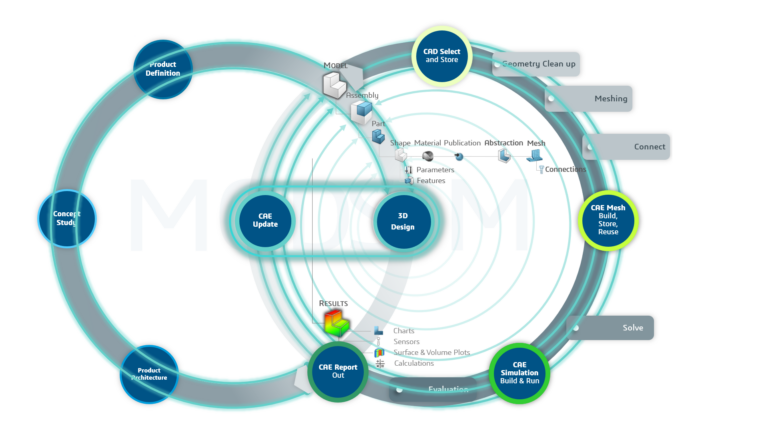
MODSIM on the 3DEXPERIENCE Platform represents a unification of modeling and simulation using a common data model under a single user experience [more].
The 3DEXPERIENCE platform facilitates and structures engineering data and process encapsulation, including built-in attribution and search, exposure to a common life-cycle management paradigm, and can be architected to mimic appropriate P&O and team-based constructs to underpin collaborative engineering pursuits.
MODSIM deployment within the 3DEXPERIENCE ecosystem thus provides data and engineering process frameworks to underpin a Connected and ‘enabled’ product validation strategy. In Figure 1, we have chosen three key pillars contributing to a Connected Validation strategy, namely:
- Simulation Model Build – Data Reuse, Enrichment & Democratization
- Simulation Governance
- Simulation Data Management & 3rd Party Data Integration

Collectively, workflow pillars such as these enable users to fully benefit from an enriched digital thread, reducing the cost and time required to simulate, evaluate and analyze product performance and compliance. They provide baseline competencies for Engineering Analysis and Simulation ecosystem transformation, targeting key challenges and pursuits centered around:
- Improving coordinated reuse of engineering data, existing simulation content and prior evidences at increasing scale, particularly in case of large multi-disciplinary teams and diverse local and global supply chains.
- Increasing workflow democratization and automation opportunity.
- Enacting and satisfying heightened and emerging regulatory and governance requirements.
- Improving digital thread persistence despite data, discipline and ‘tool’ diversity.
Simulation Model Build – Data Reuse, Enrichment & Democratization
Empowering our MODSIM strategy are core competencies centered around data reuse and enrichment. Reuse a reference to explicit, direct consumption from within a pre-existing data thread, such as a digital design definition, material specifications, an engineered template for re-purposing of common modeling exercises or a predefined configuration context. Enrichment is the addition of extra data context to a pre-existing data thread. On the one hand, a data thread contributes to a digital design definition or to the basis of a simulation model, enriching it with additional representations to host geometric abstractions (ideation) or associated finite element models.
Responding to critical design updates can become a re-purposing exercise. Engineering Templates provide a deeper construct for standardization and workflow democratization. If so parametrized, access to the model’s parametrization simplifies design space exploration, trade-off analysis, and simulation-driven robust design opportunities.
Simulation Governance
‘Test’ management on the 3DEXPERIENCE Platform provides a framework and hierarchical data structure to capture the governing context behind ‘what’ is being simulated, as well as the additional contexts behind why, when, who, and how a particular simulation or simulation study is performed. Referring to Figure 2:
- Test Specifications provide a means to represent a or a collection of inter-dependent simulations and affords the opportunity to establish contextual links to:
- A Project Space, being a sub-element of Program Management data perspective [read more].
- Requirement Specification(s) / Chapter(s) to govern the overarching purpose for a(the) simulation(s) and its intended goal and validation purpose [read more].
- A product (design) specification capturing the context of what is to be ‘tested’. This can be, for example, the ‘test’ article itself, a sub-system or even a system that the ‘test’ article contributes. The operational environment of the ‘test’ article is in focus.
- Any other attachments as deemed necessary.
- Test Cases denote a specific test (simulation) activity sub-element within a Specification, optionally governed by an execution specification (best or required practice) contained within a referenceable Test Script.
- Test Executions capture a specific execution of a Test Case. They provide an opportunity to:
- Specify the specific design ‘articles’ being ‘tested’ and acting as participants in defining the necessary ‘test’ environment.
- Link specific requirements (sub-elements of the aforementioned requirement specifications and chapter) governing the scope of the simulation
- Link any other execution specific attachments.
Test Executions can be assigned to one or more ‘actors’ and, if relevant, are exposed as tasks within a linked Project Space.
- Test Results are to capture execution result evidence, an ‘actor’ assigns status, documents expected vs. actual outcomes, and provides a segue to the author associated with the issues. Typical evidence would include the results of a simulation or resultant simulation object, a Simulation Process [read more] or an analysis report captured by a Document.
Simulation Data Management & 3rd Party Data Integration
Simulation within Defense ecosystems is typically diverse, commonly comprising different disciplines, data streams and in many cases isolated codes. This can cloud data traceability, create opportunities for data inconsistencies and gaps in traceability, and make it more difficult to implement necessary governance processes. Ultimately, slowing time to develop, ‘test,’ and certify.
Within a 3DEXPERIENCE ecosystem, we can loosely categorize simulation data into one of three classifications:
- Data derived from MODSIM Applications.
- Data derived from SIMULIA Applications connected through POWER’BY and Process Apps.
- Data derived from 3rd Party Applications connected through POWER’BY and Process Apps.
Simulation data generated by MODSIM Applications is by its nature both native and relationally managed.
POWER’BY is a technology that bridges the gap between standalone/third-party software and the unified 3DEXPERIENCE. Typical POWER’BY use cases include the consumption of geometric (design) representations authored on the 3DEXPERIENCE Platform, stand-alone pre-processing, solver execution and result post-processing, followed by contributing data upload upon completion back onto 3DEXPERIENCE encapsulated as a simulation object. It is at this point with Issue Management [read more]. Simulation results from 3rd-Party Applications require a preceding conversion using a collection of SIM API’s to support lightweight simulation data exposure and visualization via 3DEXPERIENCE Web Applications.
In the absence of a Power’by Adaptor, a Simulation Process can be authored to host a specific, user-defined target data structure, establish internal data relationships (i.e., inputs/outputs) and accommodate attributes to provide additional data context. Such a process can be deployed as a consumable, web client template. Embedded automation can manually enter or 3rd-Party Application data. The overarching process can be referenced in a Test Result (see above) or classified for further data contextualization. Process life cycle and Process Impact can be used to track and inspect the evolution of resultant and contributing data.

Interested in the latest in simulation? Looking for advice and best practices? Want to discuss simulation with fellow users and Dassault Systèmes experts? The SIMULIA Community is the place to find the latest resources for SIMULIA software and to collaborate with other users. The key that unlocks the door of innovative thinking and knowledge building, the SIMULIA Community provides you with the tools you need to expand your knowledge, whenever and wherever.

Brent is a SIMULIA Aerospace & Defense Industry Process Senior Specialist.