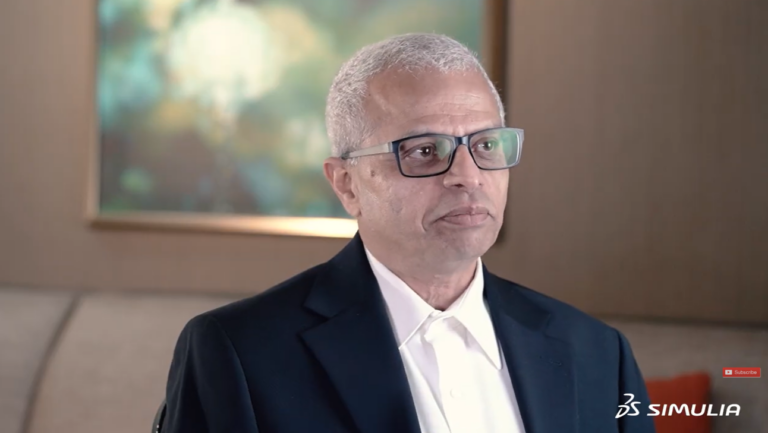
By connecting CATIA modeling and SIMULIA simulation in a unified environment, Ford has dramatically reduced engineering cycle times while enabling simulation to influence design decisions earlier than ever before.
Challenge
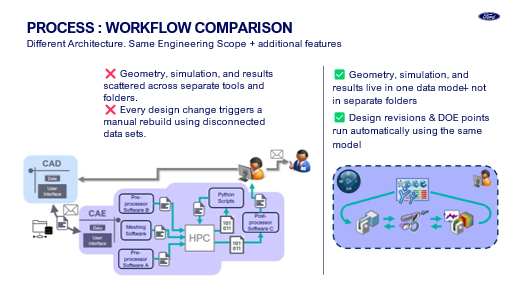
Ford’s chassis engineering team relied on siloed CAD, simulation and reporting tools that required manual file transfers and version management throughout development. As design iterations increased, engineers spent valuable time coordinating CAD updates, managing fragmented data and ensuring simulation results matched the correct design revision. The disconnected workflow slowed collaboration, limited design exploration and increased the risk of costly engineering errors.
Solution
Ford adopted a MODSIM approach on the 3DEXPERIENCE platform, integrating CATIA design data with SIMULIA simulation in a single collaborative environment. Parametric CAD models, unified model-simulation-result data and automated workflows enable engineers to explore more design alternatives while maintaining complete traceability throughout development. Instead of repeatedly requesting updated geometry, engineers can rapidly evaluate design changes and provide feedback earlier in the design process.
Results
Ford dramatically accelerated chassis development by reducing engineering workflows from days to hours, with some analyses shrinking from more than 30 hours to just 20 minutes. The unified workflow improved collaboration, eliminated manual data handling and enabled simulation to influence design much earlier in development. Engineers now spend less time managing engineering data and more time solving engineering challenges.
Engineering Begins with Trust in the Data
Modern vehicle development depends on thousands of engineering decisions. Every simulation, design revision and performance improvement relies on one simple assumption: everyone is working from the same data.
For Ford‘s Underbody Systems Engineering team, maintaining that confidence became increasingly difficult as engineering workflows grew more complex. Responsible for developing suspension systems across Ford’s North American vehicle portfolio, the team manages constant design iterations while balancing durability, stiffness, vibration performance and manufacturability.
Before adopting the 3DEXPERIENCE platform, every stage of that process depended on disconnected tools. “Before adopting 3DEXPERIENCE, all our process flows were fragmented,” Satyendra Savanur, Underbody Systems Engineering Leader at Ford Motor Company, says. “Getting CAD data meant going to another location to download it. Then we’d submit jobs, bring back the results, open another tool to review them and create reports. Every step needed a separate application.” The process worked, but every additional handoff introduced another opportunity for delays and mistakes.
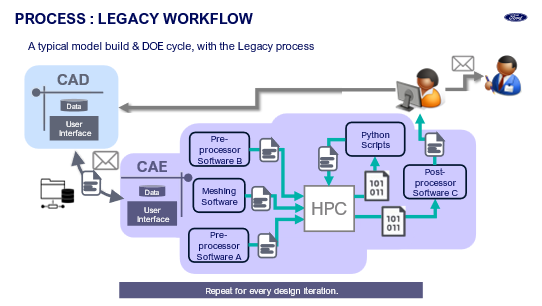
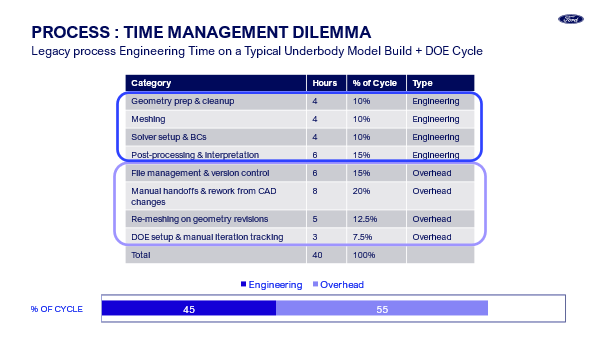
In his conference presentation, Satyendra illustrated just how much engineering capacity the legacy process consumed. Ford estimates that, in a typical underbody model-build and design-of-experiments cycle, roughly 45% of the time was spent on engineering activities, with the remaining 55% going toward overhead such as file management, manual handoffs, rework and iteration tracking.
Why Traceability Matters
As engineering programs became more iterative, keeping track of the latest design revision became almost as important as the simulation itself, as a single mistake could mean hours of lost engineering time. “There could be an instance where maybe I’m at iteration eight and by mistake I grab iteration three,” Satyendra says. “Then I realize it’s too late. I already lost four hours.”
Design exploration only magnified the problem. “When it comes to design of experiments, we deal with a lot of iterations and a lot of data,” he says. “If it is fragmented, it’s always a challenge… It’s very difficult to keep that traceability intact.”
Communication created another layer of complexity. CAD updates might arrive through email, instant messaging or text, forcing engineers to remember not only which version was correct, but also where it had been shared. “Keeping everything in the same place is really challenging,” Satyendra says. “Sometimes I even forget.. did I get the message through IM or did I get it through email?” For Ford, solving the traceability problem became the first step toward accelerating engineering.
Unifying Design and Simulation with MODSIM
Ford addressed these challenges by adopting a MODSIM approach that connects modeling and simulation within a single collaborative environment. Rather than passing CAD models back and forth between designers and analysts, engineers now work from shared, connected data throughout the entire development process.
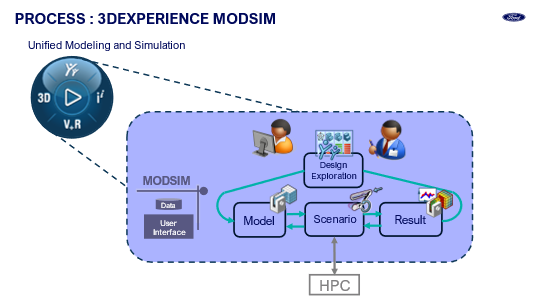
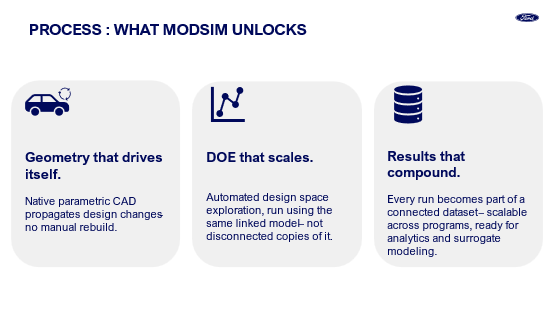
“When we switched to MODSIM, which is switching from a siloed approach to a unified approach, it made our lives really easy,” Satyendra says. “I didn’t have to do this job of calling the CAD guy or sending him an email saying, ‘Hey, I want a new version.'” Instead of rebuilding simulations every time geometry changes, engineers can work directly with parametric CAD models that preserve the relationship between design and analysis. “The best part is if he can give me a parametric CAD and coach me how to change the parameters, it’s golden,” he says. That capability fundamentally changes how Ford approaches design exploration. “I don’t have to go through that guesswork at all,” Satyendra says. “If you give me a parametric model which has all these parameters in it, I just let it run and let the design space tell me what is influencing cost. No guesswork. It’s all pure engineering and physics.”
When Simulation Drives the Design
One example illustrates how MODSIM changes the engineering process. While developing a brake dust shield, Ford engineers needed to achieve a natural frequency target to prevent vibration and unwanted noise. Instead of treating simulation as a final validation step, they used it to actively shape the component’s design. The process begins with a simple flat plate. Simulation then identifies where to add reinforcing features, such as ribs and flanges, to increase stiffness and achieve the desired performance. “We start with a flat plate, and we start adding features to it…ribs, flanges, etc.,” Satyendra says. “That typically drives the simulation back into design.”
Each simulation guides the next design iteration, allowing engineers to refine the geometry before building physical prototypes. “That’s where the power of simulation comes in,” he says. “It’s going to influence the design.” Instead of simply validating engineering decisions, simulation becomes an active participant in creating better ones.
Engineering Time Measured in Minutes Instead of Days
The impact reaches far beyond improved collaboration. In his SIMULIA Americas Users Conference presentation, Satyendra showed how a typical repetitive underbody model-build and design-of-experiments cycle that previously required about 40 hours could be completed in approximately four hours with the MODSIM workflow, recovering roughly 36 hours of engineering time per job. Based on the illustrative calculation Satyendra shared during his presentation, recovering 36 hours from a weekly workflow could represent more than $100,000 in annual engineering capacity per engineer.*These figures represent illustrative scaling based on the workflow improvement, rather than measured organizational savings.
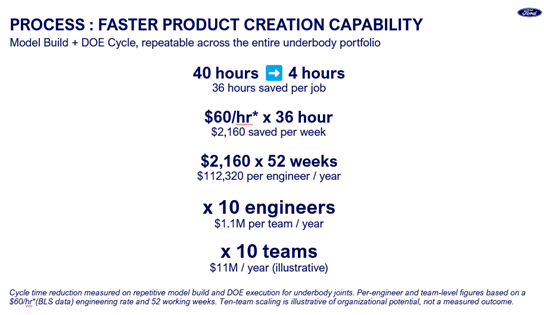
Before adopting the unified workflow, even relatively small design changes often required engineers to wait for updated CAD files, rebuild simulation models and manually reconnect engineering data before another analysis could begin.
Today, many of those activities happen seamlessly within the platform. “Certainly, in terms of efficiencies, that is day and night,” Satyendra says. “Some of the projects now are down to maybe eight hours, half a day.” Some improvements are even more dramatic. “I have some examples which can be done in 20 minutes, which used to take maybe 32 hours,” he says. Those time savings allow engineers to evaluate more design alternatives, respond to design changes faster and keep vehicle development programs moving forward without sacrificing engineering quality.
More Engineering. Less Data Management.
For Satyendra, perhaps the biggest benefit isn’t just faster simulations; it’s spending more time on engineering. Because simulation results are available sooner, engineers can influence designs from the earliest stages rather than react after key decisions have already been made.
“So, one of the things that I see is my bandwidth has really increased,” Satyendra says. “I can start affecting the design right from the beginning.” Instead of tracking files across multiple systems, engineers work from a common source of truth where CAD models, simulations and results remain connected throughout development. That faster feedback loop has strengthened collaboration between design and simulation teams while allowing engineers to focus on solving engineering problems instead of managing engineering data.
Harnessing the Power of MODSIM
For Ford, the move to MODSIM represents more than modernizing engineering software. It represents a shift toward a more connected development process where simulation guides design decisions earlier, engineering teams collaborate more effectively, and traceability is maintained from concept through validation.
“Development speed is fantastic,” Satyendra says. “We can go much faster now with this unified MODSIM approach. It makes our life so easy and, of course, fast.” For organizations considering a similar transformation, his recommendation is simple. “I would say do it now,” Satyendra says. “It’s really good technology. Fantastic technology. Go and harness the power now.”

Interested in the latest in simulation? Looking for advice and best practices? Want to discuss simulation with fellow users and Dassault Systèmes experts? The SIMULIA Community is the place to find the latest resources for SIMULIA software and to collaborate with other users. The key that unlocks the door of innovative thinking and knowledge building, the SIMULIA Community provides you with the tools you need to expand your knowledge, whenever and wherever.

Katie is the Editor of the SIMULIA blog, an expert in engineering and scientific communication, and a strategic digital marketer. Katie has a BA in English and Writing from the University of Rhode Island and a MS in Technical Communication from Northeastern University. She is also a proud SIMULIA advocate, passionate about democratizing simulation for all audiences. Katie is a native Rhode Islander who lives just outside of her favorite city, Providence. She is a true New Englander and loves sharing all the cool things NE has to offer. She enjoys a variety of hobbies including history, astronomy, science/technology, science fiction, true crime, fashion and anything associated with nature and the outdoors. She is also mom to a 6-year old budding engineer and two crazy rescue pups.