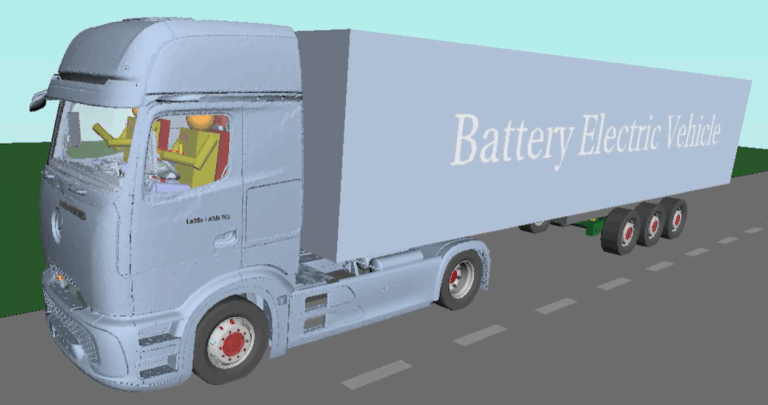
The world’s largest commercial vehicle manufacturer, Daimler Truck, uses SIMULIA simulation tools to develop a new powertrain for the Mercedes-Benz eActros 600.
Challenge
Daimler Truck set out to develop a new powertrain concept for a fully electric truck, aiming to optimize both range and performance. The team needed a way to evaluate innovative electric axle systems early in the design process.
Solution
Leveraging the capabilities of SIMULIA’s Simpack multibody system simulation software, Daimler Truck was able to simulate and validate new electric axle systems at a detailed system level, early in the development cycle. By integrating multibody and finite element models early in development, the team could identify potential issues and optimize performance before physical prototypes are built.
Results
- Enabled early-stage simulation and validation of a new rear axle design
- A shared model ensures consistency and reduces duplication
- Facilitated the creation of finite element and multibody system models
- Reduced dependency on costly prototypes and physical testing, expediting development
—
For over 100 years, Daimler Truck has led innovation in the commercial vehicle sector. “Our core purpose is ‘we work for all who keep the world moving’,” said Marc Lässing, a computer-aided engineering expert at the company. “That purpose has remained unchanged since the beginning and drives everything we do.”
Today, Daimler Truck’s approach to innovation is focused heavily on developing more sustainable logistics solutions. However, integrating electric propulsion into heavy-duty trucks presents significant engineering challenges.
“To provide the best solutions for our customers – whether that’s trucks that offer long range or high performance – we need to develop entirely new powertrain concepts,” Lässing said. “But that’s not easy, especially when working with electric motors and components that weren’t part of traditional combustion-engine designs.”
Daimler Truck has risen to the challenge with the Mercedes-Benz eActros 600 – a fully electric vehicle that redefines standards in performance, engineering, and real-world usability for long-distance haulage. The vehicle, which was named ‘International Truck of the Year 2025’, has a real-world range of 500 kilometers on a single charge and can cover well over 1,000 kilometers per day with intermediate charging during statutory driver breaks.
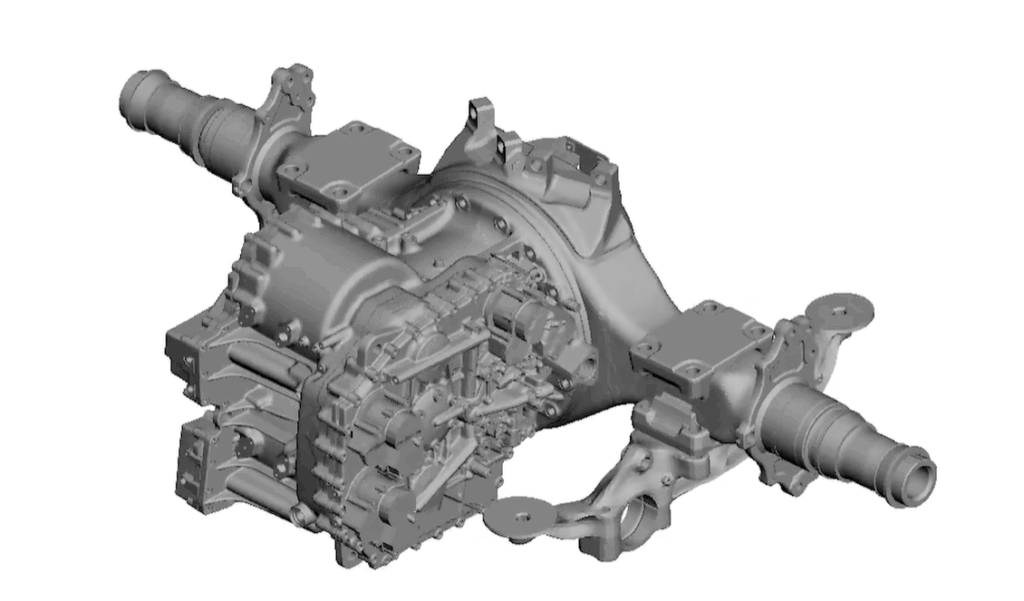
To achieve this impressive range, Daimler Truck had to rethink the entire rear axle design of the vehicle. “The compact design of the new axle allows for more space for batteries and other components essential for long-range electric driving,” Lässing said.
This is where simulation has played a vital role – delivering early insights that helped accelerate the development process.
“We use simulation early in the development process – what we call ‘front-loading’,” Lässing said. “Before any physical prototypes are built, we can simulate loads, forces and accelerations.”
SIMULIA’s Simpack software solution was particularly useful for developing the rear axle system, enabling designers to create finite element and multibody system models. “Simpack has been our key simulation tool for the last 25-30 years,” Lässing said. “We’ve built strong internal expertise with it and we use it across different teams. It has a wide variety of predefined elements and modules, which makes it easier and faster to build models with different levels of complexity.”
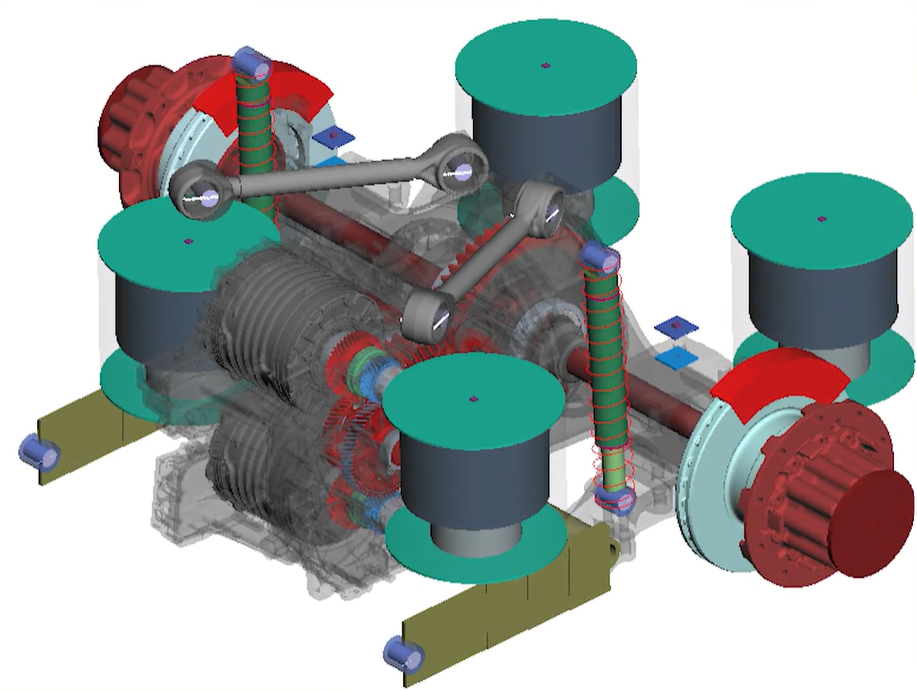
Lässing is particularly impressed with how, using Simpack, Daimler Truck can build a single model that can serve multiple teams. “If every team created its own simulation model, we’d end up with many divergent versions over time,” he said. “By using a shared model that supports varying levels of detail, we ensure consistency and reduce duplication. Each team can adjust the model as needed for their specific analysis.”
This approach has clearly paid off. Building and testing prototypes is expensive and time-consuming, but simulation helps Daimler Truck identify problems earlier and develop more efficient solutions faster. It’s no surprise, then, that Simpack will remain central to the company’s simulation strategy for the years to come.
“The Mercedes star will continue to stand for modern, powerful and efficient trucks,” Lässing said. “Tools like Simpack, which allow us to do the simulation work we need efficiently and effectively, will remain crucial as we face new challenges, particularly as we push further into electromobility and digital development processes.”

Katie is the Editor of the SIMULIA blog, an expert in engineering and scientific communication, and a strategic digital marketer. Katie has a BA in English and Writing from the University of Rhode Island and a MS in Technical Communication from Northeastern University. She is also a proud SIMULIA advocate, passionate about democratizing simulation for all audiences. Katie is a native Rhode Islander who lives just outside of her favorite city, Providence. She is a true New Englander and loves sharing all the cool things NE has to offer. She enjoys a variety of hobbies including history, astronomy, science/technology, science fiction, true crime, fashion and anything associated with nature and the outdoors. She is also mom to a 6-year old budding engineer and two crazy rescue pups.