
Military aircraft inhabit a different aerodynamic world from their commercial counterparts. A fighter aircraft must perform reliably at extreme angles of attack, with asymmetric external stores and internal weapons bay doors that open and close in flight. Each condition presents simulation challenges that conventional RANS-based CFD handles poorly — and that LBM-based PowerFLOW is particularly well-equipped to address.
A Wider, Harder Flight Envelope
The expanded flight envelope of defense aircraft spans low subsonic to Mach 2 and beyond, at angles of attack far exceeding those of commercial operations. At high angles of attack, leading-edge vortex breakdown governs stability in ways RANS cannot reliably predict. Inlet aerodynamics at transonic and supersonic conditions involves oblique shock systems and shock-boundary-layer interactions that are strongly unsteady and sensitive to small geometric details. PowerFLOW’s inherently time-accurate solvers — covering low subsonic Mach numbers to approximately 2.0 — address these complex conditions that determine structural fatigue and flight control dynamics [1].
Appendages, External Stores, and Weapons Bay Cavity Acoustics
Combat aircraft routinely fly with pylons carrying fuel tanks, targeting pods, and weapons in asymmetric combinations that change mission to mission. The aerodynamic impact of these appendages – turbulent wakes, shock impingement and buffeting loads on neighboring surfaces – must be understood not just at cruise but through the full carriage and release envelope, including the transient loads as payloads separate. PowerFLOW’s automatic Cartesian meshing eliminates the need to manually rebuild the computational grid for each new stores configuration — a task requiring weeks of manual effort in a traditional CFD workflow — making it practical to evaluate the full range of configurations a program must certify for.
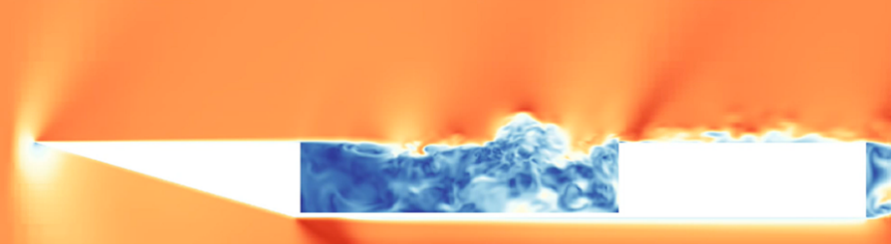
Weapon bay cavities are another difficult aerodynamic challenge: they become acoustic resonators when opened in flight, generating intense pressure fluctuations. PowerFLOW directly resolves the full spectral content of these fluctuations, including tonal peaks and broadband background without the acoustic analogies that RANS-based approaches require [2].
Adding Vibroacoustics to the Simulation Toolkit
Analyzing and improving the unsteady flow characteristics of military aircraft is only one of the benefits of an LBM-based CFD tool like PowerFLOW. Understanding the impact of aerodynamic fluctuations on vibrations of electronic components and structural fatigue can be equally or even more important. PowerFLOW achieves this by coupling to another tool in the SIMULIA arsenal – Wave6 for vibroacoustic analysis. Pressure fluctuations on weapon payloads, cavities, radomes etc. are transferred to Wave6 to assess the vibration loads sensitive components have to withstand throughout the entire flight envelope. In the words of one of our customers: “Reducing flight events and developing accurate environments earlier in a program leads to (…) acceleration of the airworthiness certification process and platform integration” [3].
Rotorcraft and Rotor-drone Aerodynamics
Military helicopters and rotary-wing drones present some of the most intricate unsteady aerodynamic problems in defense engineering. Blade vortex interaction (BVI) and tail rotor shake produce impulsive noise and vibratory loads that drive both acoustic detectability and airframe fatigue.
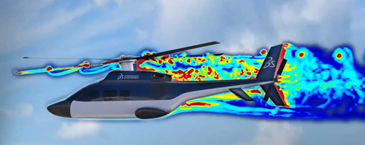
In multi-rotor drone configurations, equivalent inter-rotor wake interactions occur at every blade passage. These phenomena are inherently transient and spatially complex, demanding the time-accurate resolution of vortex structures over many rotor revolutions PowerFLOW can provide.
Drones and Rapid Multi-physics Concept Optimization
Small tactical drones — group 1 through group 3 unmanned systems operating at low altitudes and modest speeds — present a design challenge that is less about extreme aerodynamics and more about the speed and urgency of trade-off decisions that must be made early in the concept phase. These platforms are typically developed on compressed timescales with limited budgets, yet they must simultaneously satisfy tight requirements on aerodynamic endurance, acoustic signature (critical for covert operation), structural weight, thermal management of onboard electronics, and, increasingly, radar cross-section for survivability in contested airspace. Each of these disciplines interacts with the others: a body shape that minimizes radar cross-section may increase drag and reduce range; a lightweight composite structure may reflect radar energy in undesirable directions; a propulsion system optimized for efficiency may generate a thermal plume that is detectable by infrared sensors.
Multi-physics simulations integrated within the 3DEXPERIENCE platform are particularly well-suited to this compressed, multidisciplinary concept environment. With SIMULIA’s MODSIM solutions – offering automated processes that tightly integrate geometric modeling and simulation – a new drone body variant can be set up and running within hours rather than days — enabling genuine parametric sweeps across propeller diameter, body fineness ratio, inlet placement, and control surface geometry. CFD solutions, coupled to structural analysis for weight estimation and computational electromagnetics for RCS evaluation, enable a concept-phase tool chain in which dozens of design candidates can be scored against the full mission requirement set before a single physical prototype is committed to [4]. For a small tactical drone program operating under procurement pressure, that compression of the front-end design cycle — and the confidence it provides in the selected concept — can be decisive.
To learn how these advances are being applied in practice, join Swen Noelting’s live webinar, “Optimizing Performance, Stability & Robustness in Defense Aviation with Advanced CFD Simulation,” on June 2, 2026. The session will explore how Lattice-Boltzmann-based CFD supports high-speed, unsteady flow and vibration analysis across defense aircraft, drones, missiles and launch vehicles. Register here: https://events.3ds.com/advanced-cfd-defense-aviation-optimization
[1] Noelting, S., Fares, E. et al. Validation of PowerFLOW for transonic and supersonic flow regimes. AIAA Paper 2016-0585.
[2] Duda, B., Fares, E. & Noelting, S. Application of a lattice-Boltzmann method to supersonic cavity flow. AIAA Paper 2016-0046.
[3] Simpson, G. et al, Flight Test Reduction via Vibroacoustic Analysis, Presented at AIAA SciTech, January 2026.
[4] Dassault Systèmes (2022). SIMULIA for Defense: Multiphysics simulation across the platform lifecycle. White paper. Vélizy-Villacoublay: Dassault Systèmes.

Interested in the latest in simulation? Looking for advice and best practices? Want to discuss simulation with fellow users and Dassault Systèmes experts? The SIMULIA Community is the place to find the latest resources for SIMULIA software and to collaborate with other users. The key that unlocks the door of innovative thinking and knowledge building, the SIMULIA Community provides you with the tools you need to expand your knowledge, whenever and wherever.

Swen Noelting is a SIMULIA Aerospace & Defense Industry Process Director. He has a M.Sc. Mechanical & Aerospace Engineering from the University of Arizona and a Ph.D. Aerospace Engineering from Universität Stuttgart, Germany. From 1998 – 2017 he was the VP Aerospace for Exa Corporation. 2017 – present: Aerospace&Defense Industry Process Director, Dassault Systèmes