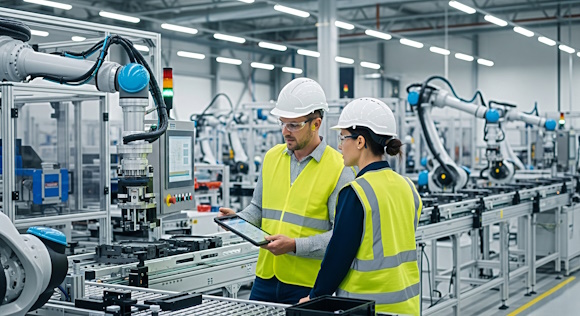
Manufacturing is undergoing structural redefinition driven by intelligent robotics. Automation is no longer limited to deterministic, high-volume repetition. Modern robotic systems integrate artificial intelligence, advanced sensing, and virtual validation to execute variable, high-precision, multi-robot workflows with minimal physical iteration.
This analysis examines the pivotal trends and technological innovations defining the future of manufacturing robotics. I explore how these transformative technologies impact production methodologies and outline strategic considerations for organizations navigating this industrial evolution.
The Emergence of Intelligent Automation
Conventional automation has served manufacturing through predictable, high-volume operations. Today’s robotics generation distinguishes itself through cognitive intelligence. By incorporating artificial intelligence (AI) and machine learning (ML) capabilities, robots now perceive environmental conditions, execute autonomous decisions, and evolve through operational experience. This evolution from programmed automation to intelligent systems represents a fundamental pillar of contemporary smart manufacturing.
AI-enabled robots address task variability that previously exceeded automated system capabilities. Advanced vision systems enable robots to identify and categorize diverse components on conveyor systems. These systems conduct quality control inspections with accuracy and consistency surpassing human performance, detecting microscopic defects invisible to traditional inspection methods. This intelligence creates adaptable, resilient production lines that respond dynamically to shifting operational demands.
Collaborative Robots: Integrating Human Intelligence with Machine Precision
Manufacturing robotics has witnessed a paradigm shift with collaborative robots, or “cobots.” Unlike conventional industrial robots operating within safety enclosures, cobots integrate seamlessly with human operators. Advanced sensor arrays detect human presence and trigger automatic deceleration or stoppage protocols to prevent collisions.
This collaborative methodology harnesses complementary human and machine capabilities. Cobots assume strenuous, repetitive, and ergonomically challenging operations—lifting heavy components or executing precise assembly motions. This redistribution enables human workers to concentrate on higher-value activities requiring critical analysis, problem-solving, and complex dexterity. The outcome is enhanced operational efficiency and workplace safety, where human potential is amplified rather than replaced.
Key Technologies Accelerating Robotic Capabilities
Several breakthrough technologies are expanding advanced robotics capabilities and broadening manufacturing applications.
AI and Machine Learning Integration
AI serves as the cognitive foundation for modern robotic systems. Machine learning algorithms enable robots to optimize movement patterns, predict maintenance requirements, and adapt to new tasks with minimal reprogramming. This continuous learning capability ensures robotic systems achieve greater efficiency and effectiveness over operational lifecycles, driving sustained process improvements.
Advanced Vision and Sensing Technologies
Sophisticated 2D and 3D vision systems provide robots with precise environmental interpretation capabilities. This technology proves essential for bin-picking operations, where robots must identify and grasp specific components from mixed-part containers. Force-torque sensors deliver tactile feedback, enabling robots to handle delicate components and perform intricate assembly tasks requiring precise pressure application.
Industrial Internet of Things (IIoT) Connectivity
Robots function as critical nodes within comprehensive Industrial Internet of Things (IIoT) networks. Connecting robots to sensor networks, machinery, and enterprise systems enables manufacturers to collect and analyze extensive real-time data streams. This connectivity provides comprehensive production process visibility, facilitating predictive maintenance, optimized resource allocation, and data-driven decision-making.
Robotics Advancing Sustainable Manufacturing
Advanced robotics plays an instrumental role in sustainable manufacturing initiatives. Process optimization through robotics significantly reduces material waste and energy consumption. Robotic coating systems apply materials with superior precision compared to manual operations, minimizing overspray and reducing volatile organic compound (VOC) usage.
Automation enables efficient recycling and remanufacturing processes. Vision-equipped robots sort mixed waste streams with exceptional accuracy, recovering valuable materials that would otherwise reach landfills. This capability supports circular economy principles, promoting responsible resource utilization.
Industries Pioneering Robotic Implementation
While robotics impacts all manufacturing sectors, specific industries lead adoption initiatives.
- Automotive: The automotive sector pioneered robotic automation and continues advancing implementation across welding, painting, and final assembly operations. Manufacturers deploy cobots to assist assembly line workers, enhancing both ergonomics and operational efficiency.
- Electronics: High-volume, precision-demanding electronics manufacturing aligns perfectly with robotic capabilities. Robots handle component assembly onto circuit boards, conduct quality inspections, and manage product packaging. Cleanroom requirements further validate robotic solutions.
- Pharmaceuticals: Pharmaceutical manufacturing demands precision and sterility. Robots execute vial filling, medication packaging, and laboratory testing operations. This implementation improves accuracy and consistency while reducing contamination risks.
Strategic Robotics Integration
Organizations considering advanced robotics adoption require comprehensive planning and strategic analysis. Success extends beyond equipment acquisition—it demands process re-evaluation and organizational preparation for operational transformation.
Identify optimal automation opportunities by focusing on repetitive, physically demanding, or error-prone tasks. Conduct thorough return-on-investment analyses considering productivity increases, quality improvements, and enhanced worker safety.
Prioritize workforce development initiatives. Robotics integration transforms employee roles across operations. Implement training and upskilling programs preparing teams for new responsibilities including robotic system operation, maintenance protocols, and production data analysis. Effective robotics strategies empower workforces rather than displacing personnel.
Select experienced technology partners capable of designing and implementing customized solutions. Collaborate with proven integrators who understand specific operational requirements. Phased implementation approaches, beginning with pilot projects, mitigate risks while building organizational momentum for broader adoption.
Manufacturing’s future is inextricably linked with robotic advancement. Organizations embracing these transformative technologies build resilient, efficient, and competitive operations, establishing foundations for the next industrial innovation era.
DELMIA, a brand of Dassault Systèmes’, provides a unified environment for designing, simulating, programming, and commissioning robotic systems using a physics-accurate virtual twin. Built on the 3DEXPERIENCE platform, it supports 2,000+ robot models, multiple PLCs and all major processes, generating validated trajectories and native robot code from a single data model. The virtual twin, combined with AI-assisted automation, cuts programming and commissioning time while enabling fast, reliable adaptation to product or production changes.

Buddharatn Ratawal has been the Sr. Manager, Strategic Business Development for the DELMIA brand at Dassault Systèmes since 2022. He is responsible for developing new and innovative business markets and reinforcing the company position as an innovative leader in key industries.