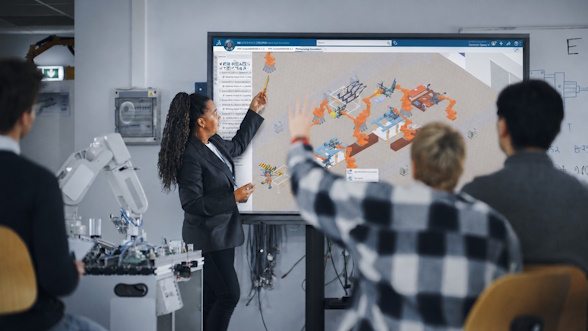
A conversation with Prof. Adam Słota, an Assistant Professor at the Chair of Production Engineering in the Faculty of Mechanical Engineering at Cracow University of Technology, on how engineering education can better align with industrial needs and how DELMIA helps bridge the gap between classroom learning and manufacturing reality.
Q: Do you see a gap today between what engineering students learn and what industry expects?
A: Yes. Industry increasingly expects graduates to understand not only design, but also how products are manufactured, validated and automated. Universities are under pressure to make education more practice-oriented, so the challenge is to teach not just theory, but how design decisions affect manufacturing, robotics and production performance.
Q: Why should manufacturers care about how engineering students are trained?
A: Because the skills gap eventually becomes an industry problem. If graduates arrive with strong CAD knowledge but little understanding of manufacturing flow, robot behavior, process constraints or automation logic, companies need to spend more time bringing them up to speed. The closer education gets to real industrial workflows, the faster young engineers can become productive.
Q: Where does DELMIA fit in that connection between classroom learning and industrial reality?
A: DELMIA is valuable because it extends engineering thinking beyond design. Students and engineers can move from product definition into layout, process validation, robot simulation and offline programming. That makes it relevant not only as a teaching tool, but also as a bridge to how industry actually works.
Q: What does industry gain when design, process planning and robotics are more connected?
A: It reduces fragmentation. In many organizations, design, tooling, manufacturing engineering and automation still work in partially disconnected ways. When those worlds are more closely connected, there is less duplication, fewer misunderstandings, and earlier validation. That improves both quality and speed.
When design, process planning and automation are better connected, quality and speed both improve,” said Prof. Adam Słota, an Assistant Professor at the Chair of Production Engineering in the Faculty of Mechanical Engineering at Cracow University of Technology
Q: Why is robotics literacy becoming important even for broader engineering roles?
A: Because robotics increasingly affects the overall manufacturing system. Even if an engineer is not a robot programmer, they still need to understand issues like reachability, sequencing, collision risk, tooling interaction and process feasibility. Those are not isolated robotics questions; they are manufacturing questions.
Q: What is the value of a more unified robotics environment?
A: From an engineering perspective, it simplifies learning and execution. Instead of switching between many brand-specific tools, engineers can work in a more consistent environment. That is valuable in education, but it is even more valuable in industry, where complexity, variants and collaboration across suppliers create additional overhead.
Q: From a business point of view, how do these capabilities translate into value?
A: The main value is earlier validation and fewer surprises. If you can test feasibility, process logic and robot behavior before installation, you reduce rework later. In industry, that means less commissioning pain, less delay, and faster ramp-up.
Q: How do you explain the value of offline programming in a broader engineering context?
A: Offline programming is important because it moves work away from the production line and into a validated digital environment. Engineers can test, refine and optimize without interfering with actual production. For industry, this supports flexibility. For education, it teaches students to think about engineering in a more disciplined and scalable way.
Q: How important is virtual commissioning from your perspective?
A: Virtual commissioning is very important. It changes the sequence of risk. Instead of waiting until physical installation to discover problems, you move validation earlier. That is strategically important for manufacturers because it reduces uncertainty. And for students, it introduces a more realistic view of modern automation, where mechanics, controls and logic are not separate silos.
Virtual commissioning changes the sequence of risk by moving validation earlier,” Slota added.
Q: Is this only relevant for large manufacturers?
A: No. Large manufacturers may feel the impact first because of their scale, but the principle applies more broadly. Any company dealing with automation, product variants, tighter timelines or integration complexity benefits from validating earlier and working more collaboratively. Smaller manufacturers may benefit even more, because they often have less margin for error.
Q: What should industry and academia do together?
A: They should collaborate more closely around real workflows, not just isolated tools. The goal is not simply to teach software. The goal is to teach engineering decisions in context: design, process, automation, validation and execution. That is where both academia and industry can benefit.
Q: How would you summarize the broader relevance of DELMIA?
A: DELMIA is useful because it helps connect engineering intent with manufacturing reality. That is relevant in the classroom, but just as relevant on the factory floor.
DELMIA, a Dassault Systèmes brand, connects the virtual and real worlds to drive innovation and sustainability. Powered by the 3DEXPERIENCE platform, our end-to-end solutions integrate virtual twins, industrial AI and augmented reality to optimize manufacturing, supply chains and workforces. We empower businesses to reduce waste and achieve sustainable, customer-focused operations, building a more resilient future.

Adam Słota is an Assistant Professor at the Chair of Production Engineering in the Faculty of Mechanical Engineering at Cracow University of Technology.