AI production scheduling uses optimization, predictive analytics and industrial AI to build feasible schedules, measure how well they run and flag risks early. It helps manufacturers move beyond a one-time plan. Schedulers can adapt faster when materials, equipment or customer priorities change.
How AI and Analytics Sharpen Production Decisions
Creating a good production schedule is hard enough. Keeping it on track when reality intervenes is a different problem.
Material shortages, equipment downtime, shifting customer priorities and workforce limits can undermine even a carefully built plan. For schedulers, the real work is adapting to what actually happens.
That’s why scheduling needs to go beyond generating an optimized plan. Manufacturers also need to see how well the plan is executed. They need to anticipate disruptions and act before small deviations become big problems.
For a VP of Manufacturing, this matters at scale. Schedule reliability affects cost, OEE and quality across every plant. Optimization, predictive analytics and industrial AI now work together to make that possible. They improve production performance and make the scheduler’s job easier.
Why AI Production Scheduling Starts With Optimization
Every successful operation needs a schedule that’s both efficient and executable.
Spreadsheets and manual scheduling often struggle with modern manufacturing. Even simple operations balance competing priorities, resource limits, material dependencies and sequencing rules against delivery commitments.
Advanced detailed scheduling meets these challenges with constraint-based optimization. It evaluates how production orders, equipment, materials and priorities interact. Then it identifies more effective schedules.
DELMIA detailed scheduling solutions, such as DELMIA Ortems, provide this foundation. They sequence work orders against routings, due dates, resource calendars and material availability. They also reschedule quickly when an order changes or a resource goes down.
But optimization alone can’t remove uncertainty. A schedule may be optimal when generated, yet conditions start changing once production begins.
So how do manufacturers know whether their schedules are performing as expected? And what can they do when they aren’t?
How Scheduling Intelligence Closes the Gap Between Planning and Execution
DELMIA Scheduling Intelligence answers that question.
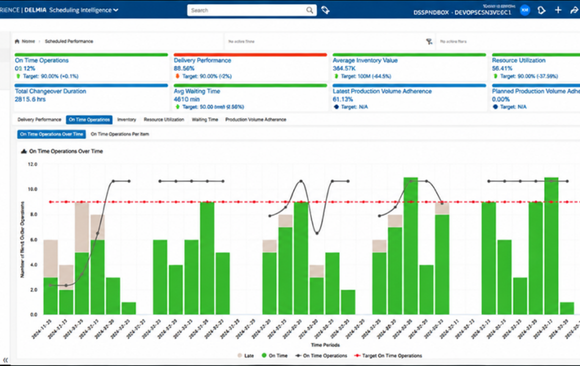
It combines historical scheduling information, operational performance data and advanced analytics. Together, they show how production plans relate to actual execution. This is industrial analytics applied to the schedule itself.
Instead of focusing only on the next schedule, teams can examine how earlier schedules performed. They can identify recurring deviations and understand why expected outcomes weren’t achieved.
For example, a manufacturer might find that certain lines consistently fall behind despite enough capacity. The cause could be unplanned downtime, recurring material shortages or variable cycle times.
DELMIA Scheduling Intelligence helps uncover these patterns through:
- Schedule adherence analysis
- Root-cause investigation
- Performance monitoring
Machine learning extends these capabilities by predicting schedule deviations and highlighting emerging risks. Schedulers can step in early, rather than discovering problems after delivery commitments are affected.
The aim is a feedback loop between planning and execution. That loop helps manufacturers keep improving schedule reliability.
Eurowipes shows what this looks like in practice. The company reports a 94% customer service level, supported by DELMIA Ortems and DELMIA Scheduling Intelligence. Its teams use AI-powered analytics to monitor schedule adherence, anticipate delays and improve planning decisions.
Watch the Eurowipes story to hear how the team uses it.
How LEO Makes Scheduling Intelligence More Accessible
Better analytics give valuable insights. Still, schedulers need to find information quickly enough to make a difference.
Production environments generate huge volumes of data. Extracting insight can mean moving through multiple applications, reports and metrics.
Dassault Systèmes is addressing this with LEO for Production Scheduling. LEO is an AI-powered Virtual Companion on the 3DEXPERIENCE platform, designed to support scheduling teams.
LEO offers a more natural way to work with production information. Alongside the usual menus, reports and dashboards, users can ask questions in everyday language and get relevant answers.
For example, a scheduler could ask:
- “How has our on-time production performance changed over the last month?”
- “Show me the trends in resource utilization for this production line.”
- “Generate a summary of our key production KPIs for the past week.”
LEO analyzes historical production data, identifies performance trends and generates KPI reports. That makes existing scheduling information easier to access and share.
LEO doesn’t replace scheduling expertise or optimization technology. It gives production professionals a more intuitive way to use the information behind their decisions.
As its capabilities grow, LEO is also intended to support more advanced activities. These include explaining operational alerts, initiating schedule optimizations and exploring alternative scenarios.
The approach pairs established industrial optimization and analytics with natural-language access grounded in the plant’s own production data. Schedulers spend less time gathering information and more time applying their expertise. It also supports the workforce of the future, because newer team members can reach insight faster.
What the Three Capabilities Deliver Together
Consider a manufacturer running a high-mix environment with frequent demand changes.
Advanced detailed scheduling creates feasible production sequences. It balances resource capacity, material availability and delivery priorities.
DELMIA Scheduling Intelligence then helps the manufacturer measure schedule adherence, identify recurring causes of disruption and predict where future performance may be at risk.
LEO for Production Scheduling adds another way to reach historical insights, explore KPI trends and generate reports through natural language.
Each capability plays a different but complementary role:
| Capability | Role |
| Detailed scheduling | Optimize the production plan under real-world constraints. |
| DELMIA Scheduling Intelligence | Understand execution performance, explain deviations and anticipate risks. |
| LEO for Production Scheduling | Make scheduling information and insights more accessible through conversational AI. |
Together, they take a more complete approach to scheduling. They cover how schedules are created, how they perform on the shop floor and how schedulers use that information to decide what’s next.
What Questions Do Production Teams Ask About AI Production Scheduling?
When scheduling teams look at how these capabilities fit together, the same practical questions come up. Here are five of them.
No. Detailed scheduling still builds the optimized schedule, and Scheduling Intelligence still measures how it performs. LEO makes both easier to work with. The scheduler remains the decision maker. When scenario capabilities arrive, LEO will propose and rank options, and the planner will choose.
The first skills cover everyday tasks. Schedulers can analyze historical production data and KPIs in plain language, from a simple data lookup to a multi-step analysis across time periods. They can also generate performance reports, from a focused three-KPI summary to a twenty-KPI review. Detecting and explaining alerts, launching and tuning optimizations and generating what-if scenarios are coming soon.
LEO works on the same scheduling data the planner already uses. Its answers are grounded in the plant’s own production history and KPIs rather than general web knowledge. LEO also never exceeds the user’s authorization perimeter, so schedulers see only what their role allows.
It archives past schedules and compares them with actual execution, by work order, by work center and against the master production schedule. Machine learning then uses that history to predict future schedule outcomes, flag likely delays and their impact, and indicate how reliable each prediction is. Schedulers can act before a deviation reaches the customer.
The value is greatest where schedules change often and constraints are tight. That includes high-mix food and beverage lines with frequent changeovers, campaign and batch production in life sciences, and complex discrete operations in automotive and aerospace. In each case, the combination helps teams keep schedules stable and understand why they drift.
For manufacturers, faster schedules are only part of the goal. The larger objective is better operational performance. That means more reliable delivery commitments, better resource utilization and greater responsiveness to change. No single technology gets you there. With DELMIA detailed scheduling, DELMIA Scheduling Intelligence and LEO for Production Scheduling, Dassault Systèmes brings these capabilities together. Schedulers can work from one set of data, from the first optimized schedule to the next adjustment. The real value of AI production scheduling is helping manufacturers deliver results, even when reality doesn’t follow the plan.
To learn more, see the latest updates in action. Watch the DELMIA What’s New sessions.
DELMIA, a Dassault Systèmes brand, connects the virtual and real worlds to drive innovation and sustainability. Powered by the 3DEXPERIENCE platform, our end-to-end solutions integrate virtual twins, industrial AI and augmented reality to optimize manufacturing, supply chains and workforces. We empower businesses to reduce waste and achieve sustainable, customer-focused operations, building a more resilient future.

Adrian Wood has been the Director of Strategic Business Development for the DELMIA brand at Dassault Systèmes since 2019. He is responsible for developing new and innovative business markets and reinforcing the company position as an innovative leader in key industries.