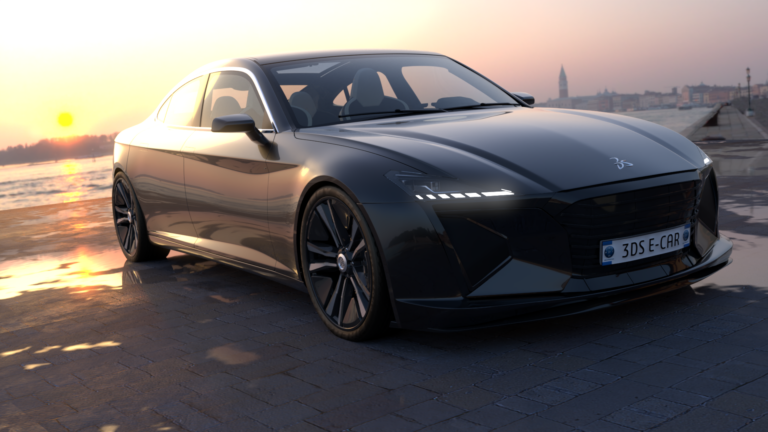


How does a designer’s 2D concept sketch evolve into a high-fidelity 3D concept car ready for engineering validation?
During a recent webinar moderated by Car Design News, CATIA experts Felix Rockel and Laura Peythieux demonstrated how modern automotive design workflows are transforming this process. Using CATIA on the 3DEXPERIENCE platform, they showcased how Sub-D modeling, parametric design, visual scripting, and generative AI can work together in a single collaborative environment.
The session explored how leading OEMs streamline creativity and engineering in one unified digital workspace. By connecting early ideation, advanced surface modeling, and collaborative workflows, designers can move from concept exploration to a detailed 3D concept car much faster while keeping the geometry ready for downstream engineering and validation.
Generating Visual Concepts and Design Contexts with AI
One of the first steps demonstrated during the session involved the use of AI to quickly generate visual environments and design contexts. By entering prompts, designers can produce images showing the car in photorealistic renderings within seconds.
The objective of this step is not to produce final visuals, but to accelerate the ideation phase. Instead of manually creating scenes from scratch, designers can generate multiple options quickly and use them as inspiration to guide the design direction right from the start of the project.
2D Image to 3D Mesh
The AI generated Images and manual produced sketches can be used as input for an AI operator that generates a 3D mesh automatically just from the image input within seconds. This 3D Mesh is the perfect input for the modelers who generated the surface model.
Translating a Concept into 3D with Sub-D Modeling
Once a visual direction is established, the next step is to build the 3D geometry of the vehicle.
Sub-D modeling allows designers to sculpt the main volumes of the car quickly while maintaining smooth and continuous surfaces. This modeling approach is particularly suited for the early stages of automotive design, where proportions and overall shape are still evolving.
During the demonstration, the speakers showed how a concept can move from an initial Sub-D model toward a more refined design stage. This transition can be achieved very quickly, allowing designers to focus on shaping the vehicle while progressively increasing the level of detail.
Automating Design Features with Visual Scripting
Another key capability highlighted in the webinar is the use of visual scripting to automate parts of the design process.
Within the scripting environment, designers can create scripts that generate specific components or geometric elements. For example, scripts can be used to generate wheels, windshields, windows, or other design features.
These scripts can be reused and modified by adjusting parameters. Instead of manually rebuilding each element, designers simply modify the inputs and the geometry updates automatically.
This approach saves time and allows teams to quickly test different design options while keeping the model structured.
Exploring Multiple Design Variations Through Parameters
Because the scripts rely on parameters, designers can easily generate multiple design variations.
By modifying parameter values, different configurations of the same design element can be created instantly. These configurations can be stored as snapshots, allowing teams to compare several versions of a design.
This parametric approach makes it possible to explore a large number of possibilities quickly without rebuilding the geometry each time. It supports the experimentation that is essential during the concept development phase.
Creating Product Experiences Directly from the Design Model
The webinar also showed how designers can build product experiences directly from the design data.
Using the tools available on the 3DEXPERIENCE platform, teams can apply materials, define lighting environments, and visualize the vehicle in different contexts. These visual experiences remain connected to the underlying design model.
This means that when the geometry evolves, the visualization updates accordingly. Stakeholders can therefore explore the design interactively and better understand the concept before it reaches later development stages.
Enabling Parallel Work Between Designers
Collaboration was another important aspect of the workflow presented during the webinar.
Multiple designers can work simultaneously on the same dataset within the 3DEXPERIENCE platform. Each contributor can focus on a specific task, such as geometry creation, scripting, or visualization.
Because all participants access the same data environment, they can work in parallel rather than waiting for sequential updates. This collaborative setup helps accelerate the overall design process while ensuring that everyone works with the latest version of the model.
Maintaining NURBS Geometry for Downstream Engineering
Throughout the workflow, the geometry generated remains based on NURBS surfaces.
This is an important point for ensuring continuity between design and engineering. NURBS surfaces can be directly reused for downstream processes such as engineering development or simulation.
By maintaining this type of geometry from the concept phase, teams avoid the need to rebuild models later in the development cycle.
Conclusion
The webinar presented by Felix Rockel and Laura Peythieux illustrates how modern design tools are reshaping the way automotive concepts are developed.
By combining AI-assisted ideation, Sub-D modeling, visual scripting, and collaborative workflows within the 3DEXPERIENCE platform, designers can accelerate the transition from a simple concept sketch to a detailed 3D concept car.
At the same time, the workflow ensures that the resulting geometry remains suitable for downstream engineering processes. This integrated approach allows design teams to move faster while maintaining the level of precision required for real-world product development.
FAQ
- How does AI support the early stages of design in this workflow?
AI is used to generate visual scenes and environments based on prompts. These images help designers explore different contexts for presenting a concept vehicle and accelerate the ideation phase.
- What is the role of Sub-D modeling in automotive design?
Sub-D modeling allows designers to quickly sculpt the main volumes of a vehicle while maintaining smooth surfaces. It is particularly useful during the early concept stage.
- How does visual scripting help designers?
Visual scripting allows designers to create scripts that generate geometric elements such as wheels or windows. By adjusting parameters, these scripts can produce different design variations automatically.
- Why is parametric design useful during concept exploration?
Parametric design allows designers to generate multiple variations of a design element by simply modifying parameters, making it easier to explore different ideas quickly.
- How does the 3DEXPERIENCE platform support collaboration?
The platform enables multiple designers to work simultaneously on the same dataset, allowing teams to collaborate in real time and accelerate the development process.
If you want to watch this insightful webinar, it’s here!
Visit our CATIA Creative Design & Styling User Community to exchange with our experts!
Who is Felix Rockel (CATIA Design Industry Process Expert) ?
Graduated in Industrial Design, Felix works for Dassault Systèmes for 11 years now, as Senior Solution Consultant and Techsales for CATIA Design.
Working in the CATIA Design IPS team, his role includes the following tasks:
– Consulting and supporting customers on the 3D design solutions
– Analyzing and consulting the Design Studio workflow and digital tool chain of its customers
– Executing sales demonstrations with the 3D design solutions for various customers from different industries
– Performing software trainings of our solution to designers and engineers of our customers – Designing various products to demonstrate our design solutions to our customers to support the sales process
Who is Laura Peythieux (Industry Process Expert Senior Specialist in CATIA Design & Engineering) ?
Laura graduated from an engineering school specializing in computer graphics. For 11 years, Laura developed the Industrial Design applications provided by Dassault Systèmes.
She is a consultant and tech sales representative for the CATIA IPS team, focusing on engineering and design topics such as Creative Design, Visual Scripting, Reverse Engineering, and Lattice Design.